

Curriculum
- 5 Sections
- 17 Lessons
- 10 Weeks
- INTRODUCTION2
- ORNAMENTS6
- EXERCISE1
- LEARNING RHYTHMS6
- ROLE OF THE DRABKI2
Overview
Online Darbuka Lessons: Learn with a Step-by-Step Method
Would you like to learn the darbuka online, discover the rhythms of the Arab world, or improve your technique? Melonea offers a complete online darbuka course designed for absolute beginners as well as experienced percussionists looking to refine their skills.
Unlike random videos found on the Internet, our lessons follow a structured learning path. Every lesson builds on the previous one, allowing you to develop solid foundations before moving on to more advanced techniques. You learn at your own pace, wherever you are, using your computer, tablet or smartphone.
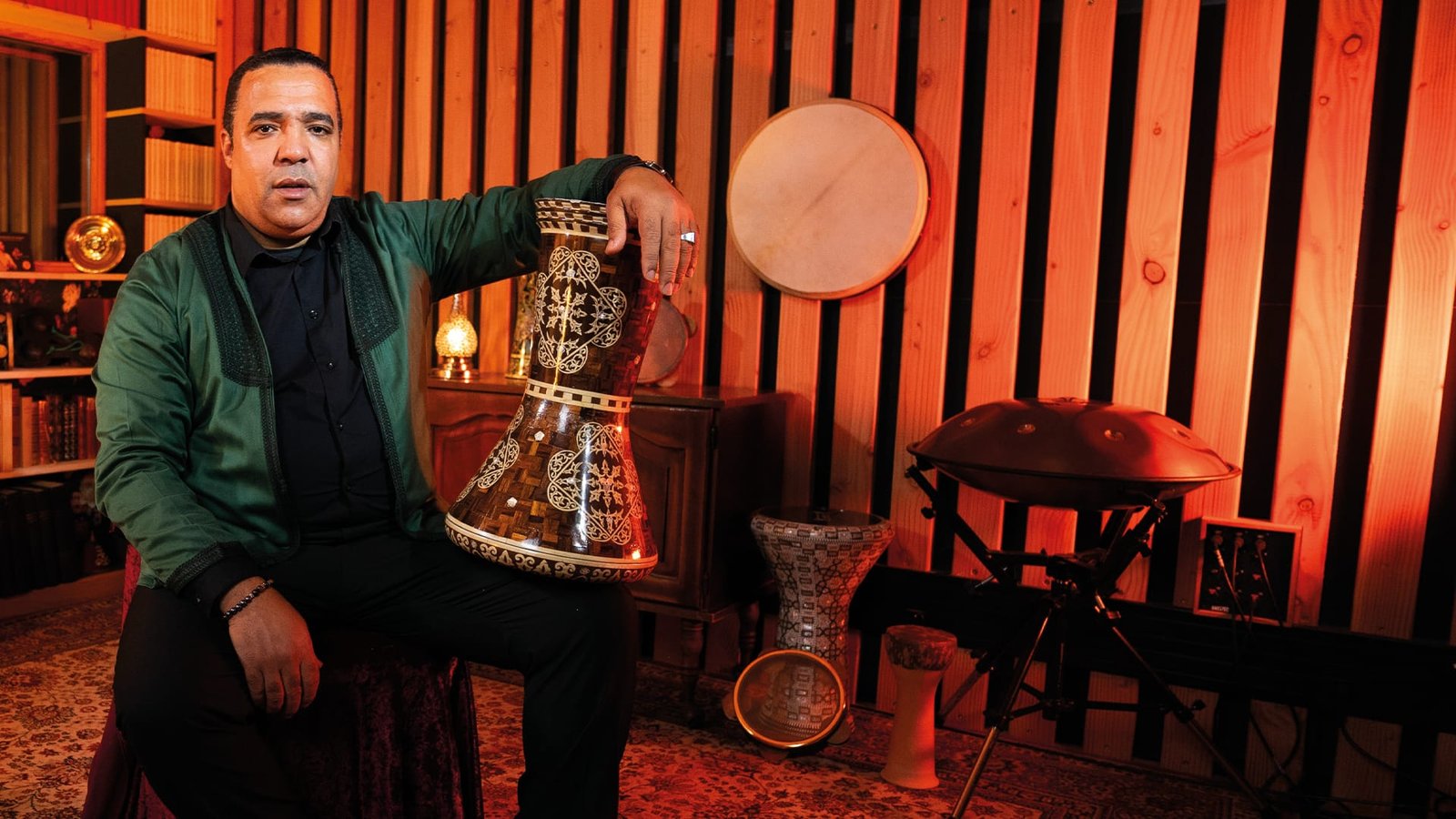
The course is taught by Ali Alaoui, a State-certified music teacher and specialist in Arabic percussion. His approach goes far beyond teaching individual strokes. He helps you understand rhythm, musicality and the role of the percussionist within an ensemble.
With a single subscription, you not only gain access to the complete darbuka course, but also to all Melonea lessons: Riqq, Bendir, Daff, Taarija, Tbal, Qraqeb, Body Rhythm, Handpan and our exclusive Arab World Polyrhythms courses.
Why Learn Darbuka with Melonea?
Today, thousands of free darbuka videos are available online. While they can be useful for discovering a rhythm or observing a specific technique, they usually lack one essential element: a structured learning progression. Many beginners jump from one video to another without knowing what to practice first or how to improve efficiently.
At Melonea, we chose a different approach. Our goal is not simply to provide video lessons, but to offer a complete learning method. Every lesson has been carefully designed to guide you step by step, from your very first strokes to mastering the most important rhythms of the Arab world.
A Clear Learning Progression
You begin by learning how to position the instrument correctly, where to place your hands and how to produce the fundamental sounds. From there, you gradually move on to rhythm exercises, essential grooves, variations, ornaments and more advanced techniques.
This progressive approach allows you to develop clean sound, precise movements and steady timing before focusing on speed. Building strong foundations first is the key to long-term progress.
A Method Focused on Musicality
Many online performances are impressive because of their speed. However, speed alone does not make a great percussionist.
In traditional Arabic orchestras, the darbuka’s main role is to support the music. A skilled percussionist listens carefully to the other musicians, accompanies the singer, follows the melody and maintains a solid pulse. This philosophy is at the heart of Melonea’s teaching method.
Rooted in Arabic Musical Traditions
Rhythms are much more than combinations of Dom and Tik strokes. Every rhythm has its own history, musical function and cultural context.
Our lessons introduce you to the rhythmic traditions of North Africa, the Middle East and the Gulf region. You will not only learn how to play each rhythm, but also when to use it, how to accompany other musicians and how to integrate it naturally into an ensemble.
Learn Anytime, Anywhere
All lessons are available 24/7. You can study whenever it suits your schedule, replay demonstrations as many times as needed and progress entirely at your own pace.
This flexibility makes it possible to improve consistently, even if you cannot attend weekly in-person lessons.
Why Learn with Ali Alaoui?
Choosing the right teacher is one of the most important decisions when learning a musical instrument. At Melonea, all darbuka lessons are taught by Ali Alaoui, a State-certified music teacher and internationally recognized specialist in Arabic percussion.
For many years, Ali Alaoui has taught students of all levels. His philosophy is simple: technique only matters when it serves the music.
His lessons focus on sound quality, precise movements, rhythmic accuracy and musical listening. Demonstrations are intentionally progressive, allowing every student to fully understand each movement before increasing the tempo.
This approach helps students build solid foundations while avoiding bad habits that can become difficult to correct later.
Beyond technique, Ali Alaoui also shares his extensive knowledge of Moroccan, North African and Middle Eastern musical traditions. Every rhythm is presented within its cultural and musical context, giving students a deeper understanding of its role and purpose.
What Is the Darbuka?
The darbuka, also known as the doumbek, tabla or goblet drum, is one of the most iconic percussion instruments of the Arab world. For centuries it has been an essential part of the music of North Africa, the Middle East and the Gulf countries, accompanying singers, orchestras and traditional ensembles.
Its rich, expressive sound allows it to fulfill many different musical roles. It provides the rhythmic foundation, supports the melody, interacts with other percussion instruments and can also become a remarkable solo instrument.
Today, the darbuka is no longer limited to traditional music. It is widely used in world music, jazz, contemporary Arabic music, fusion projects and many modern productions.
An Instrument Known by Many Names
Depending on the country, the same instrument may have different names. The terms darbuka and doumbek are the most widely used internationally, while the word tabla is common in several Arabic-speaking countries.
Although slight differences may exist between regional models, these names generally refer to the same family of goblet drums.
Traditional and Modern Construction
Modern darbukas are usually made from cast aluminum with synthetic drumheads. They offer excellent projection, stable tuning and resistance to changes in temperature and humidity.
Traditional models are often made from clay with natural skins. They produce a warmer, more organic sound but require greater care and are more sensitive to weather conditions.
Whichever model you choose, the quality of your playing depends primarily on your technique. Proper hand position, clean strokes and careful listening will always matter more than the price of the instrument.
The Fundamental Sounds of the Darbuka
Before playing complex rhythms or fast variations, every darbuka player must first master the instrument’s fundamental sounds. These sounds form the vocabulary of Arabic percussion. Just as a musician learns musical notes before performing a melody, a darbuka player builds every rhythm from a small number of essential strokes.
At Melonea, we dedicate a significant part of the beginner course to developing clean, consistent sounds. A clear, well-controlled stroke will always be more valuable than fast but inaccurate playing.
The Dom
The Dom is the deep bass sound of the darbuka. It is produced by striking the center of the drumhead with a relaxed hand. This powerful tone forms the foundation of many Middle Eastern and North African rhythms.
Throughout the course, you will learn how to produce a full, resonant Dom without unnecessary effort by using natural hand movement rather than force.
The Tik
The Tik is the high-pitched sound played near the edge of the drumhead. It creates contrast, definition and rhythmic precision.
Producing a clean Tik requires accuracy rather than strength. Proper finger placement and relaxed movement allow the sound to remain crisp even at faster tempos.
The Is
The Is is an additional stroke commonly found in many Arabic rhythms. Depending on the musical tradition, it serves different rhythmic functions and contributes to the overall flow of a pattern.
Learning how to integrate the Is naturally helps expand your rhythmic vocabulary and improves your understanding of traditional Arabic percussion.
Muted Sounds
Muted strokes add contrast and subtlety to your playing. They are particularly useful when accompanying singers or melodic instruments because they allow the percussion to support the music without becoming overpowering.
Mastering muted sounds gives your playing greater dynamics and musical expression.
Ornaments and Embellishments
Ornaments enrich the main rhythm by adding color, movement and expression while preserving its original structure.
At Melonea, embellishments are introduced progressively. Before adding decorations, students first learn to perform the basic rhythm with confidence and consistency.
Building Strong Technique
One of the biggest misconceptions about the darbuka is that speed is the ultimate goal. In reality, experienced percussionists know that beautiful sound, rhythmic precision and musical control are far more important.
A strong technical foundation allows you to play comfortably for longer periods, produce better sound and continue progressing naturally over time.
Correct Hand Position
Proper hand position makes every movement easier. From your very first lesson, you will learn how to position your hands correctly in order to develop efficient, relaxed and fluid technique.
Establishing these habits early prevents technical limitations that often slow down future progress.
Developing Steady Timing
Timing is the foundation of every style of music. Even the simplest rhythm becomes enjoyable when played with a stable pulse.
For this reason, Melonea places great emphasis on rhythm exercises designed to improve consistency before increasing speed or introducing complex variations.
Playing with Relaxation
Muscle tension is one of the biggest obstacles to technical development. Relaxed hands allow faster, cleaner and more controlled movements.
Throughout the course, you will learn how to generate power naturally while avoiding unnecessary tension, making your playing both more efficient and more enjoyable.
The Rhythms You Will Learn
The darbuka accompanies an extraordinary variety of musical styles. Every region has developed its own rhythmic traditions, accents and musical language. Understanding these differences allows you to become a more versatile and expressive musician.
Maqsoum
Maqsoum is one of the best-known Arabic rhythms. Widely used in Egyptian and Levantine music, it is often the first complete rhythm studied by beginners.
Its balanced structure makes it ideal for developing timing, coordination and the first rhythmic variations.
Baladi
The Baladi rhythm has a heavier, earthier character and is deeply rooted in Egyptian folk music. It provides excellent opportunities for learning accompaniment and developing musical dynamics.
Malfouf
Fast, energetic and highly recognizable, Malfouf is commonly used for introductions, festive music and Oriental dance. It is an excellent rhythm for improving precision while maintaining a steady pulse.
Samai
The Samai rhythm, written in 10/8, occupies a special place in classical Arabic music. Learning Samai introduces students to more sophisticated rhythmic structures and expands their understanding of traditional repertoire.
Moroccan Rhythms
One of Melonea’s unique strengths is its strong focus on Moroccan rhythmic traditions.
You will discover rhythms inspired by Andalusian music, Malhoun, Aïta, Issawa and many other traditional Moroccan styles. These musical traditions are rarely covered in most online darbuka courses, making them one of the distinctive features of Melonea.
Learning to Accompany Other Musicians
The primary role of a percussionist is to support the music. Playing as many notes as possible is not the objective. Instead, a good darbuka player strengthens the groove, reinforces the pulse and enhances the performance of the entire ensemble.
This philosophy is present throughout the Melonea course.
You will learn how to accompany singers, Oud players, Qanun players, Ney players and traditional ensembles by adapting your playing to the music rather than trying to dominate it.
This musical approach, inspired by Ali Alaoui’s teaching experience, is one of the defining characteristics of our method.
A Learning Method Designed for Long-Term Progress
Every exercise included in the Melonea course has a clear educational purpose. Nothing is practiced randomly. The lessons are carefully organized so that each new skill builds naturally upon the previous one.
As your training progresses, you will develop cleaner sounds, stronger rhythmic control, better coordination and a deeper understanding of Arabic percussion.
Whether your goal is to play traditional Arabic music, accompany other musicians or simply improve your rhythmic abilities, this structured method provides the solid foundation needed for lasting progress.
Why Choose Melonea Instead of YouTube Videos?
The Internet is full of free darbuka videos. While they can be useful for discovering a rhythm or observing a particular technique, they usually share the same limitation: they are not part of a structured learning program.
Many beginners jump from one video to another without knowing what to practice first, how to improve their technique or how to build solid foundations. As a result, progress is often slower and bad habits become difficult to correct.
At Melonea, every lesson is part of a carefully designed training program. Each exercise has a specific objective and prepares you for the next stage of your musical journey.
A Structured Learning Method
Your progression follows a logical path:
- Discovering the darbuka and proper playing position.
- Learning the fundamental sounds.
- Developing rhythmic consistency.
- Playing your first complete rhythms.
- Adding variations and ornaments.
- Learning musical accompaniment.
- Exploring advanced techniques.
This step-by-step approach allows you to build strong technical foundations while enjoying steady and lasting progress.
A Platform That Continues to Grow
Melonea is continuously evolving. New lessons, exercises, masterclasses and musical content are regularly added to the platform.
Our ambition is to build one of the leading online learning platforms dedicated to Arabic percussion and the musical traditions of North Africa, the Middle East and beyond.
One Subscription, Unlimited Access
Joining Melonea gives you access to much more than a single online darbuka course.
With one subscription, you can explore every course currently available on the platform.
- Darbuka Course
- Riqq Course
- Bendir Course
- Daff Course
- Taarija Course
- Tbal Course
- Qraqeb Course
- Body Rhythm
- Handpan
- Arab World Polyrhythms
This comprehensive approach allows you to understand how each instrument complements the others within traditional ensembles while broadening your knowledge of Arabic percussion as a whole.
Rather than learning a single instrument in isolation, you develop a deeper understanding of the rich rhythmic traditions of North Africa, the Middle East and the Gulf region.
Frequently Asked Questions
Can I really learn the darbuka online?
Absolutely. A well-structured online method combined with high-quality video demonstrations makes it possible to learn effectively from home. You can replay every lesson as many times as needed and progress at your own pace.
Are these lessons suitable for complete beginners?
Yes. The course has been designed specifically for beginners. Every concept is introduced gradually, allowing you to build confidence and develop solid foundations from your very first lesson.
Do I need to read sheet music?
No. You do not need any previous musical knowledge to begin learning the darbuka. Rhythm concepts are introduced progressively throughout the course.
Which darbuka should I buy as a beginner?
A modern aluminum darbuka fitted with a synthetic drumhead is usually the best choice. It is durable, easy to maintain and performs consistently under different weather conditions.
How much should I practice?
Practicing for 15 to 30 minutes several times a week is generally more effective than long but irregular practice sessions. Consistency is the key to steady improvement.
Is there a minimum or maximum age to learn?
No. Children can begin learning with an appropriately sized instrument, while teenagers and adults can start at any age without prior experience.
Is the course also suitable for experienced musicians?
Yes. More advanced percussionists can use the course to improve sound quality, refine their technique, expand their rhythmic vocabulary and discover traditional Moroccan, North African and Middle Eastern rhythms rarely taught elsewhere.
Can I watch the lessons on my phone or tablet?
Yes. Melonea is accessible on computers, tablets and smartphones, allowing you to practice wherever you are.
Start Your Darbuka Journey Today
Learning the darbuka is an exciting musical journey. Every new rhythm you master, every clean stroke you develop and every improvement in your timing brings you closer to the rich musical traditions of the Arab world.
Whether you want to play for pleasure, accompany singers and musicians, perform with an ensemble or simply improve your rhythmic skills, a structured learning method will make all the difference.
With Melonea, you benefit from the expertise of Ali Alaoui, a State-certified music teacher, a progressive teaching method, hundreds of video lessons and unlimited access to every course available on the platform.
You are not simply learning a collection of rhythms. You are developing a deeper understanding of Arabic percussion, musicality and the cultural traditions of North Africa, the Middle East and the Gulf region.
Join the Melonea community today and begin learning the darbuka through a clear, progressive method designed to help you improve with confidence and enjoy making music from your very first lessons.
Course Features
- Lectures 17
- Quiz 0
- Duration 10 weeks
- Skill level All levels
- Language English
- Students 4
- Assessments Yes
You May Like

BODY RHYTHM (ENG)
Learn Body Rhythm with a Step-by-Step Method Would you like to develop your sense of rhythm, improve your coordination, or discover a new way of...

HANDPAN (ENG)
Learn Handpan with a Step-by-Step Method Would you like to learn the Handpan, discover a unique musical instrument, or develop both your sense of rhythm...

POLYRHYTHMS
Discover the Polyrhythms of the Arab World Arab World polyrhythms represent one of the richest treasures of Middle Eastern and North African musical heritage. Passed...

RIQQ (ENG)
Learn the Riqq Online with a Step-by-Step Method Would you like to learn the riqq online, discover the rhythms of Arabic music, or improve your...

DAFF (ENG)
Learn the Daf Online with a Step-by-Step Method Would you like to learn the Daf online, discover the rhythms of Middle Eastern music, or improve...